
Fractional CFO Delivers 9-Month ROI Case Study
November 24, 2025 10:07 amHow a Fractional CFO Transformed Healthcare Systems for a 9-Month ROI
Many healthcare practices face common hurdles: paper forms, manual data entry, and aging accounts receivable. But for one physician group, these weren’t just minor annoyances — they were critical vulnerabilities threatening their entire operation.
This article presents a compelling case study, detailing how this specific physician group navigated a strategic transformation to overcome antiquated business processes and outdated IT systems.
We’ll explore the cascade of problems they faced, the strategic solutions implemented, and the remarkable, measurable results achieved, demonstrating how experienced financial leadership can drive significant improvements in profit and efficiency.
The solution wasn’t simply buying new software. It required strategic transformation led by experienced financial leadership.
The Breaking Point: When Old Systems Become Dangerous
The Situation That Demanded Change
This physician group faced mounting challenges that many know too well:
- Workflow bottlenecks slowing patient throughput
- Aged accounts receivable causing cash flow problems
- Data security vulnerabilities exposing patient information to risk
- Staff burnout from repetitive manual tasks
- Revenue delays from collection inefficiencies
They were caught in a productivity trap. Staff worked harder, not smarter. Technology existed to solve their problems, but they lacked the strategic vision to implement it effectively.
Without a CFO to guide transformation, they didn’t know where to start.
The Fractional CFO Approach: Strategy Before Software
Phase 1: Comprehensive Business Process Analysis
Rather than rushing to purchase the latest healthcare technology, the CFO, Andrew McCullough, began with strategic analysis:
Business Process Documentation
- Mapped existing workflows from patient intake to payment collection
- Identified bottlenecks and redundancies
- Documented staff pain points and inefficiencies
Technology Inventory and Assessment
- Catalogued all existing software solutions
- Evaluated the effectiveness and cost-benefit of each system
- Identified integration opportunities between platforms
Gap Analysis
- Pinpointed where technology could eliminate manual work
- Determined which problems required process changes versus technology solutions
- Prioritized improvements based on impact and implementation complexity
This methodical approach to healthcare technology transformation ensured that investments would solve real problems, not create new ones.
Critical Discoveries: The Hidden Costs of Outdated Systems
What the Assessment Uncovered
The CFO’s analysis revealed five major issues draining profitability:
1. Payroll Data Irregularities
The Problem: The server-based payroll system didn’t consistently synchronize time and attendance records, creating payroll errors and compliance risks.
The Hidden Cost: Staff hours spent reconciling discrepancies, plus potential labor law violations.
2. Retirement Plan Compliance Failures
The Problem: The 401(k) plan administrator relied on manual data transfers from payroll runs, creating recordkeeping compliance issues.
The Hidden Cost: Fiduciary liability exposure and potential penalties from DOL audits.
3. Front Desk Revenue Leakage
The Problem: Patient money collectible at time-of-service was routinely pushed to accounts receivable instead.
The Hidden Cost: Delayed collections, increased A/R carrying costs, and more work for billing staff.
4. Paper-Based Patient Intake
The Problem: Medical histories and intake forms were documented on paper, then manually scanned into patient charts.
The Hidden Cost: Front desk staffing costs, storage expenses, and poor patient experience with time-consuming paperwork.
5. Manual Fee Schedule Entry
The Problem: Insurance payer fee schedules were hand-keyed into the practice management system.
The Hidden Cost: Data entry errors leading to incorrect payment posting alerts, incomplete fee schedules causing missed over/under payments, and hundreds of staff hours annually.
Each issue represented an opportunity for healthcare technology transformation to deliver measurable ROI.
Strategic Solutions: Technology That Delivers Results
Transformation #1: Cloud-Based Payroll Integration
The Results:
✅ 60% reduction in payroll processing time
✅ Eliminated data synchronization errors
✅ Improved compliance with labor regulations
✅ Reduced IT maintenance costs
ROI Timeline: Payback achieved in under 8 months through labor savings alone.
Transformation #2: Retirement Plan Restructure
The Implementation:
- Separated third-party administration from recordkeeping functions
- Moved plan to a cloud-based platform with direct payroll integration
- Eliminated manual workflows between systems
The Results:
✅ Resolved all recordkeeping compliance problems
✅ Eliminated manual data transfer processes
✅ Reduced fiduciary liability exposure
✅ Improved participant experience with real-time account access
ROI Timeline: Compliance risk mitigation alone justified the investment.
Transformation #3: Front Desk Modernization
The Implementation:
- Deployed a patient registration and collection tool with EHR system integration
- Connected system to practice management platform for real-time eligibility and benefit verification
- Provided tablets for patient self-service intake
- Enabled real-time copay, deductible, and balance due calculations
The Results:
✅ Reduced front desk staffing requirements
✅ Decreased patient accounts receivable balances over 25%
✅ Improved patient satisfaction scores
✅ Eliminated paper forms and manual scanning processes
✅ Increased point-of-service collections
✅ Enhanced data security with digital records
ROI Timeline: Reduced patient A/R and staffing savings paid for implementation in the first 9 months.
Transformation #4: Fee Schedule Automation
The Implementation:
- Programmed Excel template to format payer fee schedules for system import
- Created standardized process for fee schedule updates
- Eliminated manual data entry of thousands of rows per update
The Results:
✅ Saved hundreds of staff hours annually
✅ Eliminated data entry errors in fee schedules
✅ Ensured complete and accurate payer rate information
✅ Reduced staff time spent reconciling payment posting alerts
ROI Timeline: Immediate — first fee schedule update recovered the development investment.
The Healthcare Technology Transformation Blueprint

Key Success Factors
This CFO-led transformation succeeded because it followed proven principles:
1. Strategy Before Software
Technology serves business objectives, not the other way around. Understanding workflows and pain points guided smart investment decisions.
2. Integration Over Isolation
Connected systems deliver exponentially more value than standalone solutions. The practice management, registration, and payment systems working together created seamless workflows.
3. User Experience Matters
Technology that staff and patients actually want to use gets adopted. Intuitive interfaces reduced training time and improved satisfaction.
4. Measure Everything
Tracking metrics like processing time, A/R days, and collection rates demonstrated ROI and justified continued investment.
5. Change Management Is Critical
The CFO, Andrew McCullough, guided staff through transitions with training, support, and clear communication about benefits.
Beyond Technology: The Strategic Value of Fractional CFO Leadership
Why This Transformation Required Financial Expertise
Physician groups excel at clinical care. But healthcare technology transformation requires different skills:
- Financial analysis to evaluate ROI and prioritize investments
- Vendor negotiation to secure favorable terms and pricing
- Project management to coordinate implementation across departments
- Change management to ensure staff adoption
- Performance measurement to validate results
A fractional CFO brings this expertise without the cost of a full-time executive. They’ve seen what works across multiple organizations and can avoid expensive mistakes.
Your Practice’s Technology Transformation Starts Here
Signs You Need Strategic Healthcare Technology Transformation
Ask yourself these questions:
- Are staff spending hours on manual data entry that could be automated?
- Is your accounts receivable aging beyond industry benchmarks?
- Do you have paper forms that should be digital?
- Are your systems disconnected, requiring duplicate entry?
- Do you lack visibility into key performance metrics?
- Are you unsure which technology investments would deliver the best ROI?
If you answered “yes” to any of these questions, you’re likely leaving significant money on the table.
Don’t let outdated systems hold your practice back. A fractional CFO can conduct a comprehensive assessment of your operations and create a prioritized roadmap for healthcare technology transformation.
See how strategic healthcare technology transformation can reduce processing time, improve cash flow, and position your practice for growth.
The physician group in this case study reduced payroll processing time by 60% and improved profitability significantly. Your practice could be next.
About Fractional CFO Services for Healthcare
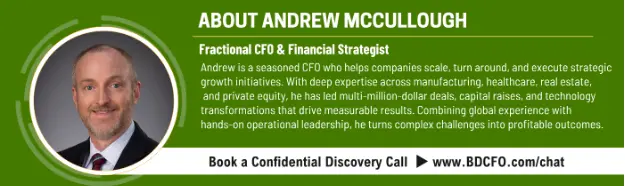
At Black Diamond CFO Solutions we provide strategic financial leadership to physician groups, specialty practices, and healthcare organizations. Our Founder & Fractional CFO, Andrew McCullough, brings decades of healthcare finance experience to guide technology transformation, cost reduction, and growth initiatives — delivering C-suite expertise at a fraction of the cost.
Ready to Transform Your Practice?
Book a Call for a Confidential Consultation.
Frequently Asked Questions
FAQ1. What are the signs that my healthcare practice needs technology transformation?
Signs include excessive manual data entry, aging accounts receivable beyond industry benchmarks, reliance on paper forms, disconnected systems requiring duplicate entries, lack of visibility into key performance metrics, and uncertainty about which technology investments would yield the best return on investment (ROI).
If you recognize any of these issues, it may be time to consider a strategic assessment to identify opportunities for improvement.
FAQ2. How can a fractional CFO help with technology transformation?
A fractional CFO can conduct comprehensive business process analyses, evaluate ROI for potential investments, negotiate with vendors for favorable terms, and manage project implementation across departments.
Additionally, they guide change management efforts to ensure staff adoption of new systems and measure performance to validate results, all while offering these services at a fraction of the cost of a full-time executive.
FAQ3. What are the potential risks of not updating outdated systems?
Failing to update outdated systems can lead to several risks, including operational inefficiencies, increased labor costs due to manual processes, compliance issues, and potential data security vulnerabilities.
These risks can result in revenue leakage, decreased patient satisfaction, and ultimately, a negative impact on the practice’s profitability. Additionally, outdated systems may hinder the ability to adapt to new regulations or market demands, putting the practice at a competitive disadvantage.
FAQ4. What types of technology solutions are most effective for healthcare practices?
They often include cloud-based systems for accounting, payroll, and retirement plans, electronic patient registration, integrated EHR/PM and billing tools, and automated fee schedule management.
These solutions streamline workflows, reduce manual data entry, enhance data security, and improve patient experiences. The key is to choose technologies that integrate well with existing systems and address specific pain points identified during a comprehensive business process analysis.
FAQ5. How long does it typically take to see ROI from technology investments?
The timeline can vary significantly based on the specific solutions implemented and the existing challenges faced by the practice. However, many practices report achieving payback within 6 to 12 months after implementing strategic technology changes.
Factors influencing this timeline include the scale of the transformation, the efficiency of the implementation process, and the extent to which the new systems address existing inefficiencies.
FAQ6. What role does change management play in technology transformation?
It ensures that staff are adequately prepared and supported during the transition to new systems. It involves clear communication about the benefits of new technologies, training for staff on how to use them, and ongoing support to address any challenges that arise.
By prioritizing change management, practices can enhance user adoption, minimize resistance, and ultimately achieve better outcomes from their technology investments.
Conclusion
Transforming outdated systems into efficient, integrated solutions can significantly enhance your practice’s productivity and profitability. By leveraging the expertise of a fractional CFO, you can identify critical inefficiencies and implement strategic technology changes that deliver measurable results.
Don’t let manual processes and disjointed systems hold your practice back; take the first step towards modernization today.
Schedule Your Free Technology Assessment
and unlock the potential for growth and improved cash flow.
Tags: Achieved ROI in under 9 months, Discover how a Fractional CFO led a healthcare tech overhaul, Fractional CFO Case Study, Healthcare Systems for a 9-Month ROI, Healthcare Technology
Categories: Case Studies